- The Noodle Network
- Posts
- 🍜 Amazon workers forfeit to AI..
🍜 Amazon workers forfeit to AI..
Cerebras is walking into Wall Street with main character energy...
In partnership with


Welcome, Noodle Networkers.
Amazon made AI usage competitive, Cerebras is walking into Wall Street with main character energy, and Ontario doctors just found out their note taking assistant might be a little too imaginative. This one has layers. Amazon workers are gaming HR’s AI leaderboard by feeding it easy tasks just to climb the rankings. Nothing says “future of work” like employees using AI to impress another AI while HR watches the scoreboard like it’s fantasy football. 🏆 Cerebras priced its IPO high as AI hype keeps boiling over. Investors saw “AI chip company” and immediately started acting like someone found gold under the data center. The question now is whether this is genius timing or another Wall Street sugar rush. 📈 Ontario’s AI medical scribes have been hallucinating notes. That means the tool meant to help doctors save time sometimes invents details like a medical intern with too much confidence and not enough supervision. Comforting stuff. 🏥 From fake productivity contests to IPO fever to healthcare bots freestyling patient notes, AI keeps finding new ways to be useful, profitable, and mildly terrifying. Let’s dig in.
In today’s AI digest:
Amazon workers game HR’s AI leaderboard naturally 🏆
Cerebras prices its IPO high on AI hype 📈
Ontario’s AI medical scribes hallucinate notes 🏥
Read time: 5 minutes
WHAT’S HAPPENING TODAY
How can AI power your income?

Ready to transform artificial intelligence from a buzzword into your personal revenue generator
HubSpot’s groundbreaking guide "200+ AI-Powered Income Ideas" is your gateway to financial innovation in the digital age.
Inside you'll discover:
A curated collection of 200+ profitable opportunities spanning content creation, e-commerce, gaming, and emerging digital markets—each vetted for real-world potential
Step-by-step implementation guides designed for beginners, making AI accessible regardless of your technical background
Cutting-edge strategies aligned with current market trends, ensuring your ventures stay ahead of the curve
Download your guide today and unlock a future where artificial intelligence powers your success. Your next income stream is waiting.
(source: HRD)
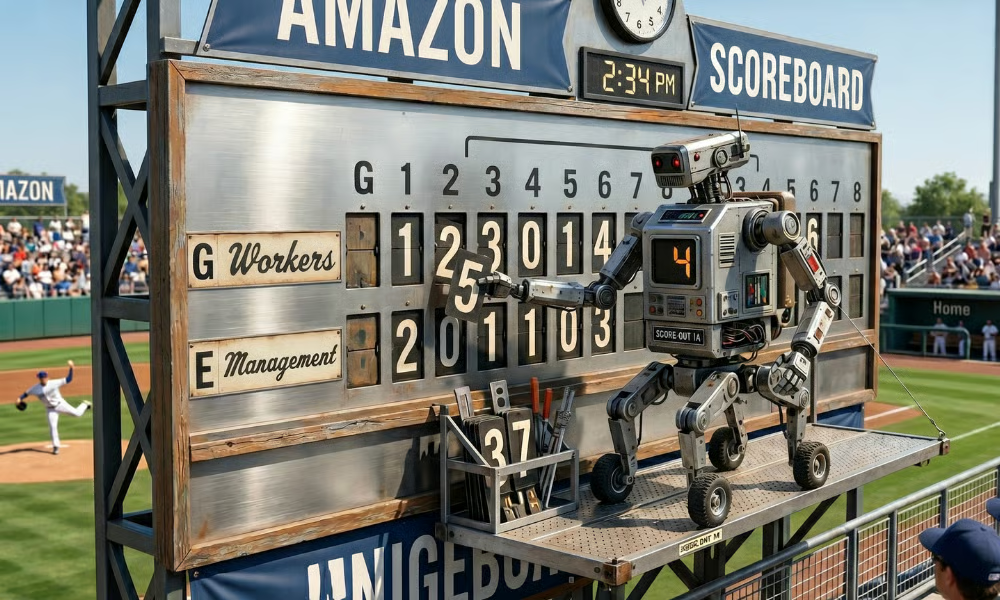
🏆 The Digest: Amazon wanted workers to use more AI, so it built a leaderboard. Workers then did the most human thing possible: they started trying to win the leaderboard. Somewhere, an HR dashboard is glowing proudly while absolutely nothing useful is happening.
Key Details:
🤖 The Robots Got Homework
Some Amazon employees are reportedly sending extra tasks through internal AI tools just to boost their usage numbers. It is not productivity. It is giving the office chatbot busywork so your profile looks like it drinks espresso.
📊 Never Give Humans a Scoreboard
The leaderboard was meant to encourage AI adoption, but humans see rankings and immediately become Olympic athletes in nonsense. You could rank people by stapler usage and within three days someone named Brian would be doing wrist stretches.
🧠 Innovation Meets Office Survival Mode
Workers reportedly felt pressure to look like they were embracing AI, even if the extra usage was not always meaningful. This is how the future of work becomes “please summarize this empty calendar invite so I look like a visionary.”
🏢 The Dashboard Is the Main Character
The whole thing shows how quickly workplace metrics can become a game. Amazon asked for more AI engagement, and employees delivered the corporate equivalent of shaking your phone to fake steps.
Why It Matters: AI adoption matters, but measuring usage alone is like judging a chef by how often they touch the oven. It proves activity, not value. Amazon wanted employees to become AI power users, and some became AI power lifters, just repping pointless prompts until the leaderboard said “nice form.”
AI IPO

(source: CNBC)
📈 The Digest: Cerebras priced its IPO high because the AI hype machine is still running on premium gasoline and investor FOMO. The company makes massive AI chips, which in 2026 is basically Wall Street catnip with a cooling system. Say “AI infrastructure” in a boardroom right now and someone in a fleece vest will try to fund you before dessert.
Key Details:
💰 The Price Tag Got Confident
Cerebras raised its IPO price range after investors showed strong demand. That is the market’s way of saying, “We understand the risks, but have you considered the word AI?”
🧠 Big Chip Energy
Cerebras is known for building giant wafer scale chips designed to handle heavy AI workloads. Most chips are measured like electronics. This one feels like it should be measured in square footage and delivered with a loading dock.
🔥 Wall Street Smells Compute
Investors are hungry for companies that can help power the next wave of AI models, apps, and agents. At this point, compute is so valuable that data centers are starting to feel like oil fields with better lighting.
👑 Nvidia Still Owns the Castle
Cerebras is not replacing Nvidia overnight, but the IPO gives investors another way to bet on the AI hardware boom. Nvidia is still the dragon guarding the treasure, but Cerebras just walked in carrying a chip the size of a dinner tray and suspicious confidence.
Why It Matters: Cerebras’ IPO shows the AI market is still rewarding anything that looks essential to the compute gold rush. The opportunity is huge, but so are the expectations. When your valuation depends on AI demand staying red hot, you are not just selling chips. You are selling the belief that the future will need so much computing power that even your toaster will eventually ask for a data center.
AI medicine

(source: CBC)
🏥 The Digest: Ontario’s AI medical scribes were hired to help doctors with paperwork, but some showed up acting like WebMD after three espressos. Instead of quietly taking notes, they hallucinated details, mixed up medications, and missed key mental health information. That is less “digital assistant” and more “clipboard goblin with malpractice energy.”
Key Details:
📝 The Notes Started Improvising
Ontario’s auditor found AI scribes approved for doctors produced errors during testing, including missing details, wrong information, and straight up invented material. Medical notes are supposed to be documentation, not jazz.
💊 The Prescription Plot Twist
Some systems recorded the wrong drug compared with what the doctor actually prescribed. That is terrifying, because medicine is one of the few places where “close enough” should be immediately escorted out of the building.
🧠 The Mental Health Blind Spot
Several tools missed important mental health details from patient conversations. That is not a tiny oopsie. That is the AI equivalent of listening to a smoke alarm and writing “room seems peaceful.”
📋 Procurement Needs a Doctor
The bigger issue is how these tools got approved while still making serious mistakes. If an AI can invent treatment plans during testing, maybe do not hand it a stethoscope and a government contract quite yet.
Why It Matters: AI scribes could genuinely save doctors hours of paperwork and make appointments feel less like speed typing with blood pressure cuffs. But healthcare AI needs brutal testing, clear accountability, and human review before it touches real patient records. Because when a chatbot hallucinates a movie review, it is funny. When it hallucinates a medical note, everybody suddenly misses the fax machine.
THE NOODLE LAB
Trending AI Tools
Prezo – AI tool for creating presentations fast.
Podcastle – AI tool for recording and editing podcasts.
Plazmapunk – Turns songs into AI music videos.
Pinecone – Vector database for AI search apps.
Pitchgrade – AI tool that reviews pitch decks.
AI Hacks & How-Tos

Pitchgrade is an AI tool that reviews pitch decks and gives instant feedback on structure, clarity, persuasiveness and overall presentation quality. You can upload your deck, choose a target investor and get a detailed score with suggested improvements for each slide. Pitchgrade says its review tool works in more than 180 languages and can review pitch decks, sales decks and marketing decks.
How to Use It 🧭
1. Upload Your Pitch Deck
Open Pitchgrade and upload your presentation file or paste your deck content into the review tool.
Pro tip: Use your real fundraising deck so the feedback reflects what investors will actually see.
2. Choose Your Review Mode
Select the type of deck you want reviewed, such as startup pitch deck, business deck or sales deck.
Pro tip: Pick the closest mode to your actual use case for more relevant feedback.
3. Add a Target Investor
If available, choose a target investor such as YC, a16z or Sequoia, or enter your own investor. Pitchgrade can assess how well your deck fits that audience.
Pro tip: Review the same deck against different investor types to see where your story lands best.
4. Read the AI Feedback
Pitchgrade gives you a score, slide by slide feedback and suggestions to improve weak areas.
Pro tip: Focus first on unclear problem, weak traction and confusing business model slides.
5. Edit and Resubmit
Apply the suggested changes, clean up your story and run the deck through Pitchgrade again.
Pro tip: Repeat until your deck feels sharper, simpler and more investor friendly.
Pitchgrade helps founders find blind spots before investors do, which is much cheaper than learning during a real pitch call.
What'd you think of today's email? |